RSS

Author Archives: Pawel Szczesny

Synthetic biology is not engineering, it’s a programming

Vierpunktlager, geteilter Innenring, zerlegbar...

Image via Wikipedia

Topic of this post has been sitting in my head for the very long time, but I couldn’t come up with a good enough opening. I’ve found it recently in the comments thread under the post on systems biology by Derek Lowe over at In the Pipeline. Citing Cellbio:

A trick of the human mind has us believe that if we rename something, we have changed the fundamental nature of the beast, but we have not.

I have taken it out of the context, but it applies very well to current situation in synthetic biology. My enormous frustration with this field comes from the fact that most of so-called synthetic biology is nothing else than genetic engineering with more systematic approach. The whole engineering meme has stuck in people’s head and many of them seem to care more about characterization of the system than about understanding how it works.

If we take a bearing from a car and from a bike, both will differ in shape and very likely one couldn’t be replaced by the other. However, their role and mechanism of work is the same, no matter in which machine we put it (this is BTW what I tried to say in my previous post on BioBricks, but judging from the comments I failed). Mainstream synthetic biology doesn’t seem to be interested in understanding how car and bike works – it’s interested in taking both of them apart as fast as possible, puting labels on the parts and pretend that now we understand how they work. And while this approach can be succesful to a certain extent in engineering, biology, especially synthetic biology, is not engineering, it’s rather a programming.

If we look at the particular component of conserved signalling pathway in two different organisms, its sequence most likely will differ. And for some pairs of organisms sequences of this component stop to be freely exchangable: they need to be mutated to fit particular chassis. Repository of information what works where is a great starting point, but it’s about the time to move further. It’s about the time to express biological systems as sets of functional roles and to build a compiler that transforms an abstract description of biological system into sequence understandable by the particular architecture (organism). This is what I think synthetic biology is all about. It’s designing by understanding.

Formalized language of biological processes sounds like a domain of systems biology, but a compiler certainly doesn’t, so such programming framework could use the best of both worlds. Can you imagine “Hello world” equivalent of a living cell? Or how would you debug program in such language? Sounds like lots of fun.

Reblog this post [with Zemanta]
 

Tags: , , ,

Photography is not a hobby. Updated CV and feedback request.

Visual resumeYesterday I asked over at FriendFeed for the feedback on my early attempt of making visual CV (big thanks to all who commented). Here’s a revised version that hopefully looks much better. The key to read the image above (click to see larger version) is as follows: Y-axis represents time (with dotted line indicating more or less the present moment); areas of interest are along X-axis; color of the phrases indicates my confidence level; font size denotes amount of time I spent on the topic (so in this case I have spent lots of time using perl, but I still don’t feel very confident about it); placement of the phrases denotes which areas of interest particular project/phrase spans; area below the dotted line shows my approximate plans and hopes for the future.

The first version had “Photography” area instead of “Visualization”, but I needed to change that since it was confusing everybody and raised questions why I put a hobby on a professional CV. Photography (or visual arts) is not my hobby. My hobby is choir singing (which I do for over 14 years already, currently singing jazz and gospel). Visualization/Photography is there to indicate that I consider data visualization one of the most important elements of scientific method. What I’m trying to figure out is what kind of presentation can help us in understanding really complex systems, such as human (genetic, to make it easier) diseases. And when we understand them curing is going to be much easier. At least I hope it will.

Anyway, the true reason to post it is to ask my readers for feedback on missing elements of my plans. So far my ideas for the future research projects split into a few paths. First path is to work further on bacterial systems (or subsystems, such as secretion systems etc.). This work would translate later on into something I call Synthetic Biology Framework, which would be a tool helping in designing new biological systems, and maybe later would result in creating a programming language for a cell. My first ideas about the framework were to design engineered bacteria producing some important compounds, maybe drugs, but now I think the cooler use for the framework would be to design bionano machines. The second path is about modelling of human diseases, with important milestone which is analysis of human genome and metagenome (genobiome as I call it) – if the data will be available. Because I don’t think I could do better here than thousands of scientists if I were using the same information, here’s a moment where synthetic biology comes into play again – I hope that I could design nanomachines that would server as quick diagnostic tools or would be reporting the body state in some mostly non-invasive way (aiming at issue of “how is my cholesterol level building up”). The third path is mostly empty and concerns visualization methods. So far I have no clear idea how to build a system that would visually assist in understanding how cells work. I plan to experiment with 3D printing and 3D visualization of biological networks, but I have no clear idea where this will lead me.

So if you have some opinion, comment, idea how to connect some dots, how to jump from one area to another (for example I have no yet idea how to approach pharmacogenomics), or if you think that it doesn’t make sense at all feel free to comment.

Reblog this post [with Zemanta]
 
3 Comments

Posted by on November 18, 2008 in Career, Research


Tags: , , , , , , , , , ,

Thinking about RaaS: Research-as-a-Service

The research li...

Image by Getty Images via Daylife

Instead of disclaimer: this is a bunch of loose thoughts on an element of a possible future of research. I’m only touching some issues here and still I don’t have coherent vision of the commercial side of research. So, feel free to show me I’m very wrong – you’ll save me lots of time of coming to your conclusions :).

According to Wikipedia, Everything as a Service is a:

concept of being able to call up re-usable, fine-grained software components across a network.

While the most common example is SaaS – Software as a Service, this concept can be applied to other functions such as communication, infrastructure or data (the last one sounds very interesting). It recently occurred to me, that investments (or maybe I should call these partnerships) of biotech and pharma companies in academic research institutions are good examples of RaaS, Research as a Service. I think every situation where the research is done after the agreement (buying or licensing patented innovation doesn’t qualify) can be called RaaS.

Why

To a company, there are obvious advantages of hiring scientists to get the research done, but I think there also would be plenty of good sides of such arrangement for us (of course I have no experience yet). Probably the biggest plus would be money and ability to get them in somehow predictable manner. I think it’s also important to be stretched intellectually from time to time (I assume that easy things aren’t worth outsourcing).

Many flavors of RaaS

Paying to an academic institution to come up with a new drug candidate is only one of many types of RaaS. There’s researching a given problem (something Innocentive or Nine Sigma are coordinating), coming up with an innovation (drug candidate example), providing expertise (consulting) or innovating and delivering (designing, building and implementing new machine, workflow or pipeline). We could find examples of all types happening everyday, but probably not in all scientific fields. Delivering something in biology is usually quite expensive and time consuming, while consulting gigs in quantum physics don’t appear all that often.

The point is that all these RaaS flavors can and are applied to academic institutions. In other words, many researchers provide commercial services using time and equipment paid from taxpayers money. And I think it’s not an issue – even more: it should be finally admitted and accepted (so we could get rid of the artificial division of researches into academic and all others; but that’s another story), and organized, so we could provide such services easier and more often.

Resources all over the place

The Health Commons project aims at building a framework that could help in sharing and organising research process aiming at developing new drugs. We seem to have lots of elements of such environment in place – we have many (or even too many 😉 ) scientists, some service providers, data centers and some work done on standards of operations and information exchange. If we forget about drug development, not much actually changes. We have workforce, some services aimed at researchers and lots of tools that help in communication in both directions.

Here’s example of research scenario: if I were to market a genetic test that identifies mutations resulting in oversensitivity or resistance to a drug (something which I believe will be the next hit after screening for disease markers), the whole research part wouldn’t require any significant involvement from my side. CRO (contract research organization) would take care of identifying patients with specific conditions, sequencing company would get me their genomes (currently $5000 each, but the price is dropping very fast) and as far as I know bioinformatics community, finding people to analyze the data wouldn’t be an issue at all. While such scenario is a bit too optimistic (I skipped lawyers in the process), we already have resources to make it happen.

Where is it going?

I imagine future RaaS provider as a small company (I’m not yet sure if a non-profit organization is a better fit for people interested in doing research; also, I don’t know how fast the issue of academic-commercial blur can be solved) made by a few scientists from different but closely related fields. The reason I see it small, is about mobility. And I don’t mean here physical mobility (which BTW may be required on some occasions) but mobility of focus – the main advantage of small organizations.

I imagine such company would be able to do consulting (and data analysis, maybe on the RedMonk model) and innovate at a software level. It would be able to do the work on site (small group again) and deliver the results quick (“bursty work”).

Pieces of this vision come from old Deepak’s posts and many FriendFeed discussions. I actually think about putting it into practice. What do you think I am missing here (other than marketing 😉 )?

Reblog this post [with Zemanta]
 
6 Comments

Posted by on November 3, 2008 in Comments, Research


Tags: , , , , , , , , ,

Qutemol and Ubuntu – native support

A Snapshot of the QuteMol open source software...

Image via Wikipedia

A week ago I got an email from a long-time-no-see friend, Marcin Feder, with information that Qutemol works fine on the Hardy and Gutsy versions of Ubuntu (binary packages were prepared by Morten Kjeldgaard; see more https://blueprints.launchpad.net/~mok0/+related-software, there are some other interesting titles there). According to Marcin following steps are enough to enjoy Qutemol on your linux box:

sudo aptitude install libungif4g  libwxbase2.8-0 libwxgtk2.8-0
wget http://mirrors.kernel.org/ubuntu/pool/main/g/glew/libglew1.4_1.4.0-1ubuntu1_i386.debhttp://ppa.launchpad.net/mok0/ubuntu/pool/main/q/qutemol/qutemol_0.4.1~cvs20080130-0ubuntu1~gutsy~ppa1_i386.deb
sudo dpkg -i libglew1.4_1.4.0-1ubuntu1_i386.deb
sudo dpkg -i qutemol_0.4.1~cvs20080130-0ubuntu1~gutsy~ppa1_i386.deb
I have too ancient Ubuntu version to check it right now, but not all of you are so lazy with upgrades so have fun.
Reblog this post [with Zemanta]
 
5 Comments

Posted by on October 16, 2008 in Visualization


Tags: , , ,

Personal Development for Smart People: review of Steve Pavlina book

Personal development wasn’t so far the subject of any post on this blog, and that’s not a surprise – it’s hard to hard to measure, hard to study and full of published trash. However, I’m interested in the topic and one of my favourite blog on the topic is “Personal Development for Smart People” written by Steve Pavlina. While Steve is quite controversial (as you’d expect from somebody who develops his physic abilities, is a raw foodists and experiments with polyphasic sleep) and I sometimes strongly disagree with him or have a hard time believing in some stories, often enough he writes very interesting and useful articles.

When he announced that his book will be released in October, I was planning to buy it but I got a pre-release as a part of promotion offer. The offer required to post a review, not to praise the book, so here’s my honest and biased opinion.

I will not go into detail on the contents of the book. You can get a pretty good feeling what it is about here. The book doesn’t overlap very much with excesive content of Steve’s blog – most of the practical issues of self-development are covered on the blog, the rest is pretty much original.

This is not an easy book and it will not leave you happy and motivated. It’s not easy not only because it requires some basic knowledge (for example, Law of Attraction mentioned few times is not defined anywhere), but it will ask you to question lots of your beliefs and assumption. For example, Steve asks to rate several aspects of your life, and then re-rate anything below 8 as 1, claiming that if you don’t have exactly what you really want, you simply don’t have it, period. You can call it a trick, but taking it seriously may be somehow difficult. Also, it doesn’t have any motivational stories, it doesn’t call you to act or to punch your chest – it has just down to earth description of the process of personal growth. My biggest complain was that it was too short – it felt like an introduction, not comprehensive guide. Also, from a scientist point of view (I know, this is not research paper) I missed some background and comparison to ideas other people have written over the years.

You can read this book and extract lots of practical hints on how to achieve something faster/more efficiently, or how to develop necessary habits, but it’s not definitely why this book was written – from my perspective it’s an invitation to think more seriously about personal growth and to challenge the status quo of what we think about ourselves. And I would like to accent the word “invitation”. Steve is not aggressive and does not try obsessively to prove he is right (as it happens too often in other books). It’s an invitation you don’t have to answer.

What’s in this book for scientists? That’s a hard question. This book wasn’t written for scientists, poker players, truck drivers or startup founders. It was written for people who want to grow and need some help on the way. Definitely, it can serve as a reminder that even science should be ethical and should provide a value, but on the other hand I don’t think majority of you need that reminder at all. As a side note, Steve explains in the book why scientists (and other professions) are paid so little (he calls it low social value), but we knew that anyway :).

What I got from the book was help in making my non-profit plans more clear. Although you don’t need to start a non-profit to find this book worth reading.

You can order the book at Amazon.

Reblog this post [with Zemanta]
 
3 Comments

Posted by on October 16, 2008 in Comments


Tags: , ,

Open Access Day

Today is the world’s first Open Access Day . It aims at broadening awareness and understanding of OA. The approach is to make as many people as possible to blog today on the topic, possibly answering the following questions:

  • Why does Open Access matter to you?

In my case, where pretty soon I’ll have no support from a large institution, Open Access means ability to do research. OA is a vital help to small or underfunded research groups.

  • How did you first become aware of it?

Internal policy of my former employer required that all results should be published in OA journals. BTW, it didn’t change since then.

  • Why should scientific and medical research be an open-access resource for the world?

Ability to do research and to innovate shouldn’t be inhibited by access to knowledge and data produced by publicly funded research institutions.

  • What do you do to support Open Access, and what can others do?

I do publish in OA journals (four out of five publications I have so far are OA).

See more OA Day entries at FriendFeed Open Access Day room.

Reblog this post [with Zemanta]
 
Comments Off on Open Access Day

Posted by on October 14, 2008 in Community, Research


Tags: , , ,

Many Eyes and literature summary

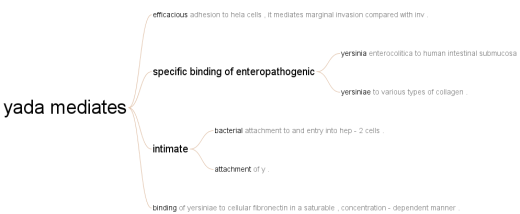
I’m not the first one to come up with this idea – Ntino posted about it before. However, I didn’t really understand before how powerful it could be. Using Many Eyes visualization capabilities I’ve created a quick browsable summary of abstracts related to a particular protein. I took all abstracts PubMed returned for a particular query (in this case it was “YadA Yersinia”; YadA is a prominent adhesin and important pathogenicity factor in Yersiniae) and uploaded them as text into Many Eyes. I chose “Word Tree” representation and searched for “yada”, which gave a nice graph of the most prominent phases related to this protein/gene name. Maybe it’s not a breakthrough, but compared to the classification/semantification provided by GoPubMed, such approach works much better for entities that aren’t well described in biological ontologies.

Given that the whole concept is pretty straightforward, it would be nice if one of alternative PubMed search engines provided a similar method of summarizing user’s query, don’t you think?

Reblog this post [with Zemanta]
 
9 Comments

Posted by on October 4, 2008 in Papers, Research, Visualization


Tags: , , , , , , ,

Future of Science on the (ZuiPrezi) map

I’ve just stumbled across map of predictions about global science and innovation created at a recent IFTF workshop in Singapore (the interface is a novel service for online presentation called ZuiPrezi – it looks very promising and I’m waiting for it to come out of private beta). The map contains a few points that resonate with my own scientific interests:

  • bioelectricity, microbial fuel cells and self-assembly for molecular electronics were for me areas where synthetic biology comes into play
  • scientific publications changing from journals to articles and proposal to make an institute for free exchange of ideas looked like indications that Science 2.0 memes are spreading very well
  • and finally, I’m happy to see more people believing that real-time, non-invasive and possibly 3D sensing of biological processes (aka “how is my cholesterol level building up?”) will be available sooner than in 50 years

As usuall with such predictions, I feel like many of them are quite conservative – or even schematic. Only very few were completely new to me, but that’s not necessarily a bad thing. It means that actually most of these predictions will turn out to be true in some time. I would like to see something that would immediately blow me away, but on the other hand it’s all relative :).

Reblog this post [with Zemanta]
 
1 Comment

Posted by on September 30, 2008 in Comments, Research


Tags: , , , ,

Skyrails and STRING

Of course I couldn’t resist not to play a little bit with Skyrails after I saw it at Flowing Data blog. Skyrails is a graph visualization system that was designed with expandability and awesome look in mind. All menus can be programmed in odd-looking, but quite easy to learn language, which helps in writing customized interface to particular data.

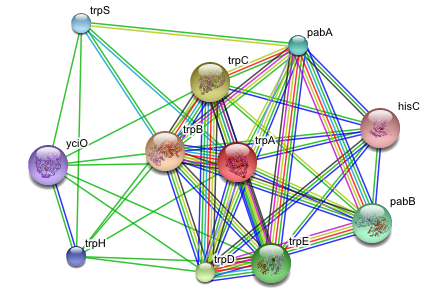
My quick attempt was to take some sample data from STRING, feed it into Skyrails and see if that makes any sense. My choice was #1 example from STRING main page, which was trpA protein from E. coli K12. The main graph on the trpA interactions page looks as follows:

The same graph in Skyrails:

Of course Skyrails has a 3D representation, is fully interactive, with a little work one can filter some of the connections out, put images of structures instead of green dots, etc. etc. It doesn’t look as clear as STRING, because it wasn’t optimized for such use – in practice it’s much clearer. The video below shows the basic interactions with this dataset.

Is it useful? At the moment, not really. It has already lots of features that more mature programs lack (completely programmable menus are great idea), but usage is still crude and in some cases the flashy effects are disturbing. However, it’s worth to keep an eye on Skyrails. First, development is pretty much guaranteed, as the author said he starts a PhD on this project. Second, the basic roadmap includes features that again aren’t present anywhere else, like client-server architecture (so you can talk to Skyrails system from external application – dynamic, time-aware visualization?). And third – it’s the most cool-looking visualization system I’ve found so far (will it make into a movie, like Genome Valence from Ben Fry did?).

Reblog this post [with Zemanta]
 
2 Comments

Posted by on September 9, 2008 in Software, Visualization


Tags: , , , ,

Data from Bioinformatics Career Survey posted

Data analysis of Bioinformatics Career Survey

Data analysis of Bioinformatics Career Survey

Michael Barton did a great job of collecting and cleaning data for First Bioinformatics Career Survey. Raw results are available at Github and please read also details on the analysis and sharing results over at OWW page.

Michael encouraged to go wild with an analysis, so here’s my quick look at the data. On the image above you can see a scatter plot of salary vs years in the field (top), histogram of salaries (bottom left), histogram of planned years in the field and histogram of positions (bottom right). All plots are colored according to the positions.

There some obvious things in these graphs, such as correlations between position and salary or between years in the field and position (see also the video below). But what strikes me is the plot showing estimated number of years in the field. There are some local maxima at around 5, 20 and 30 years, but its very interesting to see that ca. half of the people see themselves in bioinformatics for another 25-30 years and longer, and there’s no clear correlation between positions of these people and these predictions (other than senior/PI-level staff doesn’t like an idea of working for another 30-40 years). The reason I find it interesting is that I have no idea how bioinformatics will look like in these 20-30 years (and that was the reason I’ve put conservative 5 years in this field). Do you know? Do you have an idea how bioinformatics will look like so much time ahead?

Reblog this post [with Zemanta]
 
Comments Off on Data from Bioinformatics Career Survey posted

Posted by on September 2, 2008 in bioinformatics, Career


Tags: , ,