RSS

Changes and updates

Here’s a summary of changes that happened in the meantime on Freelancing Science blog:

  • Freelancing Science has its own domain (freelancingscience.com in case you wonder), but for readers nothing changed: all links, feed urls seem to work as they did so far. The main change is in your browser’s address bar and my email (pawel at new domain name).
  • I have added another box with Google Reader starred items. Feel free to subscribe, although I star something in GR based on my loose impression (not necessarily valid) that particular piece is worth coming back to. Because my reading list is constantly enlarging (more on this below), expect large amount of items in this feed.
  • I’ve added a number of blogs to link list in the sidebar (this list is constantly expanding). Among others there are: blog of Daniel Lemire, computer science professor from Montreal, Reasonable Deviations – everything scientific and challenging, from math to finances, Molgraph3D – visualization (of course!) of molecules with various techniques by Ludovic Autin and Biosingularity – news blog about advances in bioengineering.
  • I keep updating Images of molecules page, although I put all new stuff also in my Flickr “Molecular renderings” set, which is easy to track as it provides RSS feeds (to track people’s lifestreams I recommend FriendFeed – couple of fellow biobloggers have their account there).
 
Comments Off on Changes and updates

Posted by on March 21, 2008 in Comments


Tags: , ,

Semi-automated workflows – Taverna Interaction Service

I was still thinking about recent Neil’s wondering about possibility of automating every scientific workflow, when I saw this (Bioinformatics Advance Access abstract):

The Taverna Interaction Service: enabling manual interaction in workflows by Anders Lanzén and Tom Oinn

Taverna is an application that eases the integration of tools and databases for life science research by the construction of workflows. The Taverna Interaction Service extends the functionality of Taverna by defining human interaction within a workflow and acting as a mediation layer between the automated workflow engine and one or more users.

I have not tried it yet but this Taverna plugin is very likely an answer to doubts I often have when automation of bioinformatics workflows is discussed: we shouldn’t always remove ourselves from the workflow, as interaction with software can be often critical in making a discovery. For example conscious decision about which sequences should go in during PSI-BLAST search can dramatically influence quality of resulting profile. So I agree with Neil that not every workflow can be automated, but more importantly not every workflow should be. Possibility of wrapping one’s mind around a problem is gone when there’s no feedback loop on the process.

 
Comments Off on Semi-automated workflows – Taverna Interaction Service

Posted by on March 12, 2008 in bioinformatics, Papers, PubMed


Tags: , ,

Mining PubMed – another tools available

There are two new tools available that mine semantically PubMed abstracts, e-LiSe and Anne O’Tate. First one was made by my colleagues from Institute of Biochemistry and Biophysics in Warsaw, while the second is from University of Illinois, Chicago. Female-sounding names is not the only thing that makes them look similar, they both provide analogous functionality, like keywords or author names associated with user query.

There’s quite a lot of third party interfaces to PubMed (see David Rothman’s excellent list), so I couldn’t resist to run few queries on both servers and compare them to GoPubmed, which currently wins hands down in terms of features and interface. I wasn’t surprised to see that results overlap significantly, although not completely. Each of servers found valuable keywords other two did not have – that’s understandable, they use different algorithms. I wonder if we will see a meta-server of PubMed data-miners, like there are for protein structure prediction (for example meta.bioinfo.pl). In theory, exhaustive search for meaningful keywords by different methods and then their classification and analysis should work better than any single method, but this is just a guess.

 
5 Comments

Posted by on March 5, 2008 in bioinformatics, Data mining, PubMed


Tags: , , ,

Life of a freelancing scientist – few observations

This post is mainly to indicate that I’m alive and blogging plus I wanted to share a few observations from my two month long freelancing scientist life:

1. If you are unemployed, but affiliated with an academic institution, applying for grants is OK, but getting an award for young and (possibly) smart is most of the time not possible (formal employment is usually required)

2. It takes very little time to sink in new projects (it’s me right now), after you’ve announced that you go freelance. That usually means:

3. It can take little time to go from no-salary to almost-a-salary-from-several-grants. Count grant turnover times in.

4. You have a lot (I mean really a lot) of skills that can be useful outside the academia. So useful that others may want to pay for them (I’ll let you know in a few months). And I’m not talking about programming.

5. You can switch the field in no time. It’s like going for a postdoc, sinking in projects and after few weeks deciding that after all it’s not that interesting. Although I keep in mind that I need to settle to have anything done.

 
3 Comments

Posted by on March 3, 2008 in Career


Tags: , ,

Outsiders and great scientists

Last weeks brought another worth reading pieces on being a scientist: one in PLoS Computational Biology (found via The Evilutionary Biologist) and one over at Adaptative Complexity blog (found via Genome Technology). I would add a third one, albeit not strictly about scientists. This is “The power of the marginal” by Paul Graham. Graham in general writes about start-ups, but in this particular essay he put an advice, that I keep repeating myself over and over again:

If most of your ideas aren’t stupid, you’re probably being too conservative. You’re not bracketing the problem.

When I look back over the ideas I had, they could be categorized into four main groups: the ones that were published couple of years before I found them, the ones that were published just before, the ones that were published just after I started to work on them and finally the ideas I’m still working on because they were not published yet. In this light, Graham’s advice seems to me a pretty good way to escape this schema.

 
Comments Off on Outsiders and great scientists

Posted by on February 25, 2008 in Career, Research skills


Tags: , , , ,

Importance of null models – slides by Kevin Karplus

Again, a short note today (but I have some longer posts on the way). I’ve just fished reading slides of the talk Kevin Karplus had given on the 3DSig (satellite conference of the last ISMB in Vienna). The talk was entitled: Better than chance: the importance of null models. If you haven’t been there, I hope take-home messages will convince you to have a look:

  • Base your null models on biologically meaningful null hypotheses, not just computationally convenient math.
  • Generative models and simulation can be useful for more complicated models.
  • Picking the right model remains more art than science.

Very good connection of math skills and a feeling of biological problems.

 
Comments Off on Importance of null models – slides by Kevin Karplus

Posted by on February 21, 2008 in bioinformatics, Structure prediction


Tags: , , , ,

Breaking news: structure of usher pore solved

My colleague is at Grenoble on the conference about host-pathogen interactions. Today he sent me important news: Gabriel Waksman (that’s not surprising to anybody interested in structural biology of bacterial pathogenesis) showed structure of usher pore – soon to be published.

Why is that important? Usher is a membrane part of two component system responsible for assembly and transport of fimbriae/pili in gram-negative bacteria – pretty essential element in these organisms. This protein was identified in early 90s (or even earlier) and for quite a while lots of people tried to solve/predict/model its structure. Its structure was assumed to resemble porin – but a large insert right in the middle of beta-barrel gave lots of problems in predicting correct topology. Now we know (at least my colleague saw it, we need to wait) how the final structure looks like and I was also told that its functional aspects have a big relevance to other secretion systems. Have a look on this protein when it’s out (I’ll post definitely about it) – I think you will be surprised even if nuances of host-pathogen interactions are not very appealing to you.

Studying any niche area on the molecular level can be very rewarding. Novel protein fold by itself is not a big deal anymore (it used to be – browse through archives of Nat. Struc. Biol. from several years ago). But putting this novel structure in well known functional context and understanding constrains that led to a new solution is still considered a first-class science.


Tags: , , ,

Can a biologist fix a radio?

[via Molecule of the Day] Go and read (if you haven’t before) this brilliant piece on modern biology: Can a Biologist Fix a Radio? Read it twice if you call yourself bioinformatician…

 
2 Comments

Posted by on February 5, 2008 in bioinformatics, Fun


Tags: , ,

Peptide and Protein Building Blocks for Synthetic Biology – EHC Broomley et al.

With my background in protein sequence analysis and recently increasing interest in synthetic biology/biological engineering, Deepak’s post about BioBrick project immediately caught my eye. However, after spending some time around registry of standard biological parts I realized that using full natural proteins as modules wasn’t very appealing to me. My thoughts oscillated in area between nanotechnology at a atomic level, and BioBrick approach – my idea for “a brick” was something from supersecondary structure elements to protein domains.

While I was trying to figure out what was done in this area, here’s what appeared in Google Reader: Peptide and Protein Building Blocks for Synthetic Biology: From Programming Biomolecules to Self-Organized Biomolecular Systems by E.H.C. Broomley, K. Channon, E. Moutevelis and D.N. Woolfson (DOI: http://dx.doi.org/10.1021/cb700249v). It’s not an open access paper, but you can download it from Dek Woolfson lab page. This review summarizes several different approaches to synthetic biology focusing specifically on peptides and proteins as a prime component of newly engineered machines. Why actually peptides and proteins? Here are some points from the paper:

  • efficient, reproducible and spontaneous folding with all information usually encoded in the polypeptide chain
  • organization of the folded structures, including secondary structure elements (referred there as tectons), which naturally limits the possible number of folds, but gives enough different structural scaffolds to display many biological functions
  • frequently observed self-assembly of folded structures into higher-order complexes/nanomachines

The review gives examples of selected protein folding motifs (like collagens or zinc-fingers) that can be used in designing novel fibrous materials, but describes in great detail various assemblies made of protein coiled-coils.

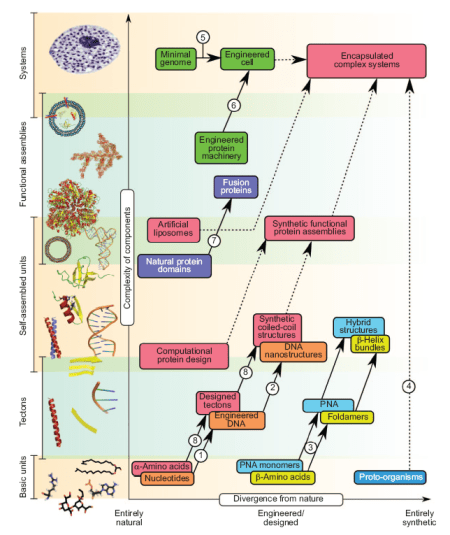
Being pretty familiar with coiled-coil structures, I was rather more interested in general view on the field – and I wasn’t disappointed. Below I copied first figure from this paper (for its legend see the original paper) – it’s a beautiful breakdown of different methodologies in synthetic biology. You can place on this graph most approaches people are taking in this area (from Venter’s bacteria, through BioBricks, to DNA cubes).

Peptide and Protein Building Blocks for Synthetic Biology - EHC Bromley et al.

 
Comments Off on Peptide and Protein Building Blocks for Synthetic Biology – EHC Broomley et al.

Posted by on February 4, 2008 in Biological engineering, Papers, Synthetic biology


Tags: , , ,