RSS

Monthly Archives: October 2007

Wolfram Mathematica 6 – no New Kind of Science (yet)

Not so long ago Animesh Sharma pointed to quite old interview of Steven Wolfram about the book “The New Kind of Science” and asked if concepts concerning a biological framework made their way into Mathematica software.

I’ve just returned from Poland Mathematica Conference, and I can answer that question: no, they didn’t. While there were people using Modelica and Mathematica to model some stochastic processes in cells, Mathematica itself does not provide much of a support for any sophisticated description of biological mechanisms. Implications of concepts from The New Kind of Science book looked very promising – it’s a pity that we are not given tools to verify them ourselves.

 
1 Comment

Posted by on October 30, 2007 in bioinformatics, Comments, Software


Tags: , ,

My gallery of images

Readers of this blog who rely on RSS feeds may have not noticed that I had put a separate page containing computer-generated images of various molecules – Molecular renderings. Any comments, suggestions, critique are always welcome.

From time to time I’ll post new images there – from time to time I need to remind myself that science is pretty too :).

 
Comments Off on My gallery of images

Posted by on October 28, 2007 in Comments, Visualization


Tags:

Qutemol rendering

Impressive thing about Qutemol rendering with ambient occlusion is that this method is used in real time. I’ve put a small video showing a difference between typical rendering and Qutemol’s method (well, I hope it’s visible, quality of this video is pretty bad, but it’s my first file posted on YouTube).

The bad thing about Qutemol is that so far it works mostly only on the Windows OS (I’m not the last person having problems running it on the OSX). Linux users are out of luck – Qutemol needs hardware support for 3D rendering, so a virtual machine with Windows is not a solution.

 
2 Comments

Posted by on October 26, 2007 in bioinformatics, Software, Visualization


Tags: , ,

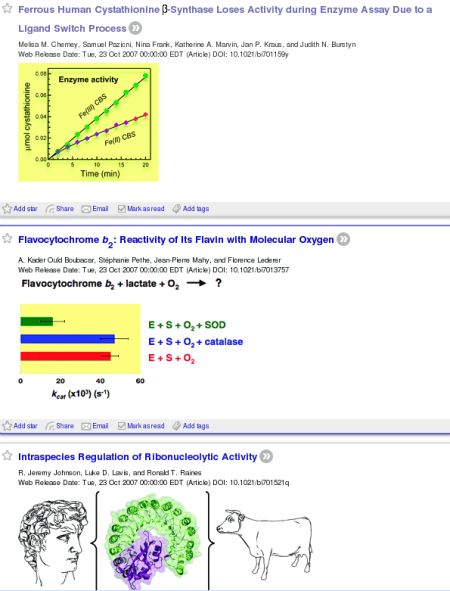
Publishers, please provide images in the journal’s feed

Currently almost all scientific journals provide a RSS feed of their content. I am very grateful for that, as many other scientists. However, I see a large disproportion between what I would like to scan through and what I’m actually able to. Abstracts, which are usually provided in these feeds, look almost exactly the same, and after thirty or fifty I’m not really sure if I understand what I read (most likely even Robert Scoble would have the same problem, although at a different level). Biochemistry journal found a solution (see below) – providing images instead of abstracts in the feed (in fact, they used this approach on their homepage long before RSS feeds became a standard). It’s simple, very effective and I have no idea at all why it’s not more popular. So here I’m asking – publishers of scientific journals: please give me images in the journal’s feed. I don’t mind having also the abstracts, but visual summary would be much more useful. In return I promise read these feeds instead of relying on Pubmed searches or my colleagues recommendations and GR shared items.

Feed of Biochemistry journal

 
1 Comment

Posted by on October 23, 2007 in Papers, PubMed, Research skills


Tags: , , ,

Biology Image Library – scientific stock photography?

(via The Biotech Weblog) BioMed Central has launched the Biology Image Library – online collection of scientifically interesting and meaningful images across biology and biomedicine.

Most of the images at BIL are available free of charge for non-commercial purposes (like teaching), but buying commercial-use rights is also possible. I don’t really agree that the library is aimed at students (teachers, lecturers – maybe), since personal subscriptions are $293 per annum and I could imagine that institute subscriptions are not cheaper. UPDATE: See comments below. To me a corporate client is a main target of this initiative, but I may agree that relatively high subscription rates may be dictated by the nature of the images – most of them come from experiments (almost no computer generated illustrations).

Microstock photography sites hold quite a lot of science-related images, however their scientific value is very often zero (as an example, search for DNA). It is overall nice idea to have a scientific equivalent of a microstock, but I would rather leave the subscriptions out and release low quality (for web/computer screen use) material under non-commercial Creative Commons license.

clipped from www.biologyimagelibrary.com

What is the Biology Image Library?

The library is a collection of images, illustrations, movies and animations that are useful for research and education. It is also a new, easy way to share your work with others without losing any rights to it or limiting how you use it in the future.

Who publishes the library?

The library is published by BioMed Central, an independent publishing house that offers a wide variety of journals and other online services. BioMed Central is committed to providing immediate open access to peer-reviewed biomedical research. We also publish a number of “value-added” subscription databases and information services, of which the Biology Image Library is an example. Please see www.biomedcentral.com for more information about our activities.

  blog it
 
4 Comments

Posted by on October 22, 2007 in Clipped, open-science, Services


Tags: , ,

Bio::Blogs #16 – call for submissions

I got the privilege of hosting the next edition of Bio::Blogs. If you have anything you would like to have included please send an email to szczesny dot pawel at gmail dot com or to bioblogs at gmail dot com before 1st of November.

 
2 Comments

Posted by on October 20, 2007 in bioinformatics, Community


Tags: , , ,

Genome Commons – knowledgebase of human genetic variation

The title says it all – have a look at Steve Brenner’s commentary in Nature (looks like its freely accessible) and the Genome Commons web page.

clipped from genomecommons.berkeley.edu
The Genome Commons and Genome Commons Navigators are open resources I propose to assist with personal genome interpretation. A commentary describing these has been published in Nature, and additional versions of those musings and more details may be found on the about page of this site.

Thank you very much for your interest. Please explore the site and offer your thoughts. The background page offers some historical context for the Genome Commons idea. More valuable context is given by the resources page, which summarizes some existing resources for personal genome interpretation, with links to much larger lists of resources. The blog will have updates and discussions.

  blog it
 
1 Comment

Posted by on October 17, 2007 in Clipped, Research


Tags: ,

Blender in visualization of molecules

Yes, you can use Blender to prepare figures for your next paper and the results for sure will look different than the ones obtained with a standard software (hemoglobin [1HBG] as example below)… But given amount of work and really steep learning curve (at least for somebody who tries that for the very first time), I would not recommend Blender that much… 🙂

Hemoglobin

UPDATE: if you look for a way to import a PDB file into Blender, some instructions are at the bottom of this page.

 
10 Comments

Posted by on October 17, 2007 in Software, Visualization


Tags: , , ,

Thoughts on CASP – Critical assessment of methods of protein structure prediction

I’ve just read an introduction to the supplemental issue of the journal PROTEINS, dedicated to the most recent round of the CASP experiment. It describes the progress of the protein structure prediction over the last few CASP editions.

The list of advancements include:

  • improvement of the homology modelling: one of the issues in template-based modelling of protein structures was that a final model wasn’t closer to the real structure than a template; now we have statistically significant (although very small) improvement thanks to the multi-template based modelling
  • fully automated methods are much closer to human predictors than ever: many groups use models from servers as their starting point and usually they don’t improve them that much

I believe that this was possible thanks to the progress that has been made in the area of sequence homology searches. Finding similarity between two sequences well beyond any reasonable identity thresholds is now doable thanks to profile-to-profile comparison, meta-servers (joining predictions from many different methods) or recent hmm-to-hmm algorithms (comparison of Hidden Markov Models). If you can find a suitable template for your protein, the rest is then much easier, isn’t it?

There are of course fields that still need some work. One of these often stirs a lot of discussion: automated assessing of model similarity to the real structure. The current methods have proven their suitability, I definitely agree. However I hope that at some point the protein structure comparison software will refuse to superimpose eight- and ten-stranded beta-barrels or left- and right-handed coiled-coil with a message: “It doesn’t make sense.”

CASP 7 logo

 
Comments Off on Thoughts on CASP – Critical assessment of methods of protein structure prediction

Posted by on October 10, 2007 in Comments, Papers, Research, Structure prediction


Tags: , , , ,

Type VII secretion system

Yet another secretion system was described, this time from Gram-positive bacteria (types I to VI were from Gram-negative). I expect that the further microbiology will go from E. coli, the more secretion systems will be found. Within the large spectrum of bacterial species we still know very little on bacteria outside proteobacterial group.

This is from Nature Reviews Microbiology, and subscription may be required.

clipped from www.nature.com

Recent evidence shows that mycobacteria have developed novel and specialized secretion systems for the transport of extracellular proteins across their hydrophobic, and highly impermeable, cell wall. Strikingly, mycobacterial genomes encode up to five of these transport systems. Two of these systems, ESX-1 and ESX-5, are involved in virulence — they both affect the cell-to-cell migration of pathogenic mycobacteria. Here, we discuss this novel secretion pathway and consider variants that are present in various Gram-positive bacteria. Given the unique composition of this secretion system, and its general importance, we propose that, in line with the accepted nomenclature, it should be called type VII secretion.

  blog it
 
Comments Off on Type VII secretion system

Posted by on October 9, 2007 in Clipped, Proteins, Secretion system


Tags: , ,