RSS

Visualization software for molecular assemblies by Thomas Goddard and Thomas Ferrin

Recently, among articles “in press” from Current Opinion in Structural Biology I found a paper by Thomas Goddard and Thomas Ferrin about software for visualization of large molecular assemblies. Even if the focus of this paper is not preparation of publication quality pictures, software cited there sounds familiar: Chimera, Pymol, VMD, Qutemol. The authors mention also VISION, which is a visual programming environment capable of presenting molecular data. Molecular Graphics Lab of Scripps Research Institute that works on the VISION has some other interesting tools, including PMV – Python Molecular Viewer, which I hope to cover some other time.

Anyway, this paper actually reminded me of something. I did mention that new version of Chimera can produce input for Povray, but I did not realize that it’s not the only change in this version. After upgrading to the current version I found out that it has also several “presets” of settings suitable for on-screen viewing or producing the figure. That makes preparation of the figure much faster and if you still don’t like the results you get good starting points for some tweaking.

Test image from Chimera

 
Comments Off on Visualization software for molecular assemblies by Thomas Goddard and Thomas Ferrin

Posted by on September 1, 2007 in Papers, Visualization


RSS is the new WWW

I accidentally found a brilliant way of summarizing news buzz. Picture below documents phrases “x is the new y” collected from various sources in 2005. I’m wondering how this kind of study would look like in science…

Here is the source.

 
Comments Off on RSS is the new WWW

Posted by on August 21, 2007 in Visualization


Many Eyes for bioinformatics?

It’s already a while since IBM launched their data visualization framework Many Eyes. While initially resistant (there’s nothing that Gnuplot/R/Graphviz cannot do) I’ve decided to have a closer look. Obviously I didn’t get it before – Many Eyes is not about making the visualization easier (although IBM did quite a lot in that direction). It’s about sharing both data and approach to that data.

Many Eyes encourages to test things. A single perl one-liner and we see the most often occuring domains in proteins of Bacillus anthracis:

Conserved domains of Bacillus anthracis

Or maybe we want to know which of these domains co-occur (nex to each other) in a single protein (only the biggest cluster shown):

Co-occurence of conserved domains in Bacillus anthracis

(note that this is the output of quick hacks – I wouldn’t call it a scientific analysis)
Many Eyes is a service for general data. What about making such thing for the biological data analysis? The workflows may be shared on the myExperiment, and the data (input and output, and a visualization of the latter) on a site like Many Eyes? And deposition of the data would be required for certain papers? So far the results of the bioinformatic analysis are (sometimes) attached as a supplementary material in some weird format (pdf or doc). This at least make it accessible for years, but there’s no access to the original data and no way to verify if the analysis was correct other than looking at the results (and usually that’s not enough). Is there anything like that available? If not, do you think it would be valuable to build a service like that?

 
2 Comments

Posted by on August 19, 2007 in Software, Visualization


On the scripting skills

The interview with dr Alexei Drummond inspired an interesting discussion. While I agree that some level of training in programming would be very beneficial for the biologists, I think that there’s something more important people working at the bench should learn – using the tools for biological data analysis. The scripting skills are fine, they save often enormous amount of time, however not willing to learn how to do a BLAST search (or any other basic tool in the field) and interpret results, leads to publishing papers with errors (the best case) or with completely wrong conclusions (that is more often). I’m not talking about becoming an expert – this can take years, like in programming and this should be left to people spending the whole day doing data analysis (aka bioinformaticians). I’m talking about “scripting” equivalent of programming and this level is currently taught on bioinformatics undergraduate courses at most of the universities. Such training would save the world from papers comparing multiple sequence alignments from Clustal and… BLAST (if some readers do not know – BLAST at best can produce multiple pairwise alignment; it does not align all the sequences together).
These are my two cents. I hope to hear your opinion on that.

 
3 Comments

Posted by on August 19, 2007 in Comments, Research skills


Structure of molecular needle

After yesterday’s post it’s no secret anymore that I’m interested (among other things) in oligomeric prokaryotic proteins. I often browse recent additions at PDB and see if there’s a new, exciting and pretty (symmetric) structure deposited. A week ago a picture similar to this below drew my attention.

PDB 2v6l

This nice ring of helices is a model of the molecular needle of type III secretion system (T3SS). This system is used by many bacterial species during an infection: attaching to the host cell is followed by a insertion of a needle into the host cell and transporting effector proteins directly into that cell. The model here is a combination of the crystal structure of the single subunit and 3D reconstruction of the needle from electron microscopy.

I believe that next years will bring more full atom models of important cell structures. It can be seen directly from the publications: certain research groups are solving structures of missing elements of the large protein complexes, one by one. The model above is for sure a one step closer to having the whole T3SS, including cytoplasmic, transmembrane and extracellular parts at a atomic resolution.

The paper about this model was published last year in PNAS (free access) by Janet E. Deane and Pietro Roversi et al. The model is deposited in the PDB as 2V6L. PubMed ID for the abstract is: 16888041.

 
2 Comments

Posted by on August 8, 2007 in Papers, Proteins, Secretion system


Publication quality pictures of biomolecules

One short note: I’ve started this blog with a hope that maybe I would write something useful for the next Bio::Blogs edition, which would send me first visitors. To my surprise this site was found almost within hours from the first post by Pedro Beltrao. It looks like science bloggers never sleep :).

Last year I had a chance to make a short course on protein structure prediction. One of the points I made was preparing the publication quality pictures of the models. While the Rasmol (I’m linking to open source version here) has definitely its well deserved place on the scientists computers, it is not the best choice for publication figures. My personal suggestions are listed below:

  • VMD by UIUC – my favourite, steep learning curve, writes POVRay files, recent version includes Tachyon renderer and is able to use a neat feature – “ambient occlusion
  • Chimera by UCSF – pretty easy to use, recent version can render biomolecules with POVRay
  • Pymol by DeLano Scientific – easy as Rasmol, has internal renderer capable producing very nice images, another favourite for completely different reasons than VMD
  • Qutemol by ISTI-CNR – pretty new software and to me still in alpha state, impressive real-time rendering with ambient occlusion, capable of producing images in prof. David Goodsell style (see Molecule of the Month at PDB)
  • Molscript by Avatar Software, the oldest and the most difficult to use, however the clarity of the final image is often hard to beat

Of course three first programs can do much more than just visualize the protein structure – they can be used in detailed structural analysis, can do superimpositions of protein structures, analyze trajectories from molecular simulations, display density maps, deal with alignments and many other things.

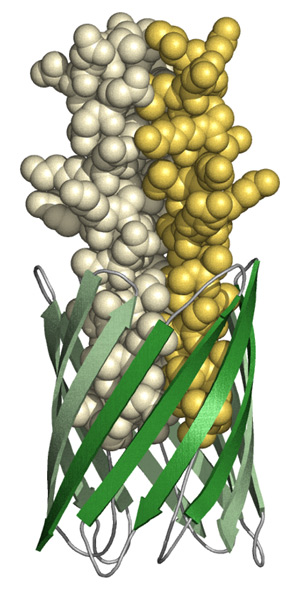
Below you can find examples of images obtained with the above software. YadA adhesin picture has an “artsy” look, but at least it shows wide range of possibilities.

YadA adhesin VMD

TAA membrane anchorPymol

YadA adhesin headMolscript

 
24 Comments

Posted by on August 7, 2007 in Software, Visualization


Why freelancing science?

There are many definitions of bioinformatics. They range from “handling biological data with a computer” to a very extensive and precise descriptions, including even subdivisions. In general they agree on one thing: bioinformatics is used for virtually unlimited number of tasks. Whether it’s a sequence analysis, handling microarray data, juggling chemical reaction parameters – as long as it’s around living things, it’s considered a bio(chem)informatics.

I don’t see a need to invent yet another name for it. But freelancing science keeps coming to my mind all the time. Switching the system your are working on during a coffee break or doing something in your own way instead of following “the protocol” has its “freelancing” feeling, doesn’t it? 🙂

 
3 Comments

Posted by on August 7, 2007 in Comments


Hello from WordPress

While I use many of Google’s online tools, WordPress is my preferred blogging engine. So here it is. Freelancing Science blog. A place to discuss and share issues of protein analysis and evolution, bioinformatics tools and tricks, and finally the open science. I hope you’ll enjoy this site.

 
Comments Off on Hello from WordPress

Posted by on August 7, 2007 in Dump-all