RSS

Monthly Archives: February 2008

Outsiders and great scientists

Last weeks brought another worth reading pieces on being a scientist: one in PLoS Computational Biology (found via The Evilutionary Biologist) and one over at Adaptative Complexity blog (found via Genome Technology). I would add a third one, albeit not strictly about scientists. This is “The power of the marginal” by Paul Graham. Graham in general writes about start-ups, but in this particular essay he put an advice, that I keep repeating myself over and over again:

If most of your ideas aren’t stupid, you’re probably being too conservative. You’re not bracketing the problem.

When I look back over the ideas I had, they could be categorized into four main groups: the ones that were published couple of years before I found them, the ones that were published just before, the ones that were published just after I started to work on them and finally the ideas I’m still working on because they were not published yet. In this light, Graham’s advice seems to me a pretty good way to escape this schema.

 
Comments Off on Outsiders and great scientists

Posted by on February 25, 2008 in Career, Research skills


Tags: , , , ,

Importance of null models – slides by Kevin Karplus

Again, a short note today (but I have some longer posts on the way). I’ve just fished reading slides of the talk Kevin Karplus had given on the 3DSig (satellite conference of the last ISMB in Vienna). The talk was entitled: Better than chance: the importance of null models. If you haven’t been there, I hope take-home messages will convince you to have a look:

  • Base your null models on biologically meaningful null hypotheses, not just computationally convenient math.
  • Generative models and simulation can be useful for more complicated models.
  • Picking the right model remains more art than science.

Very good connection of math skills and a feeling of biological problems.

 
Comments Off on Importance of null models – slides by Kevin Karplus

Posted by on February 21, 2008 in bioinformatics, Structure prediction


Tags: , , , ,

Breaking news: structure of usher pore solved

My colleague is at Grenoble on the conference about host-pathogen interactions. Today he sent me important news: Gabriel Waksman (that’s not surprising to anybody interested in structural biology of bacterial pathogenesis) showed structure of usher pore – soon to be published.

Why is that important? Usher is a membrane part of two component system responsible for assembly and transport of fimbriae/pili in gram-negative bacteria – pretty essential element in these organisms. This protein was identified in early 90s (or even earlier) and for quite a while lots of people tried to solve/predict/model its structure. Its structure was assumed to resemble porin – but a large insert right in the middle of beta-barrel gave lots of problems in predicting correct topology. Now we know (at least my colleague saw it, we need to wait) how the final structure looks like and I was also told that its functional aspects have a big relevance to other secretion systems. Have a look on this protein when it’s out (I’ll post definitely about it) – I think you will be surprised even if nuances of host-pathogen interactions are not very appealing to you.

Studying any niche area on the molecular level can be very rewarding. Novel protein fold by itself is not a big deal anymore (it used to be – browse through archives of Nat. Struc. Biol. from several years ago). But putting this novel structure in well known functional context and understanding constrains that led to a new solution is still considered a first-class science.


Tags: , , ,

Can a biologist fix a radio?

[via Molecule of the Day] Go and read (if you haven’t before) this brilliant piece on modern biology: Can a Biologist Fix a Radio? Read it twice if you call yourself bioinformatician…

 
2 Comments

Posted by on February 5, 2008 in bioinformatics, Fun


Tags: , ,

Peptide and Protein Building Blocks for Synthetic Biology – EHC Broomley et al.

With my background in protein sequence analysis and recently increasing interest in synthetic biology/biological engineering, Deepak’s post about BioBrick project immediately caught my eye. However, after spending some time around registry of standard biological parts I realized that using full natural proteins as modules wasn’t very appealing to me. My thoughts oscillated in area between nanotechnology at a atomic level, and BioBrick approach – my idea for “a brick” was something from supersecondary structure elements to protein domains.

While I was trying to figure out what was done in this area, here’s what appeared in Google Reader: Peptide and Protein Building Blocks for Synthetic Biology: From Programming Biomolecules to Self-Organized Biomolecular Systems by E.H.C. Broomley, K. Channon, E. Moutevelis and D.N. Woolfson (DOI: http://dx.doi.org/10.1021/cb700249v). It’s not an open access paper, but you can download it from Dek Woolfson lab page. This review summarizes several different approaches to synthetic biology focusing specifically on peptides and proteins as a prime component of newly engineered machines. Why actually peptides and proteins? Here are some points from the paper:

  • efficient, reproducible and spontaneous folding with all information usually encoded in the polypeptide chain
  • organization of the folded structures, including secondary structure elements (referred there as tectons), which naturally limits the possible number of folds, but gives enough different structural scaffolds to display many biological functions
  • frequently observed self-assembly of folded structures into higher-order complexes/nanomachines

The review gives examples of selected protein folding motifs (like collagens or zinc-fingers) that can be used in designing novel fibrous materials, but describes in great detail various assemblies made of protein coiled-coils.

Being pretty familiar with coiled-coil structures, I was rather more interested in general view on the field – and I wasn’t disappointed. Below I copied first figure from this paper (for its legend see the original paper) – it’s a beautiful breakdown of different methodologies in synthetic biology. You can place on this graph most approaches people are taking in this area (from Venter’s bacteria, through BioBricks, to DNA cubes).
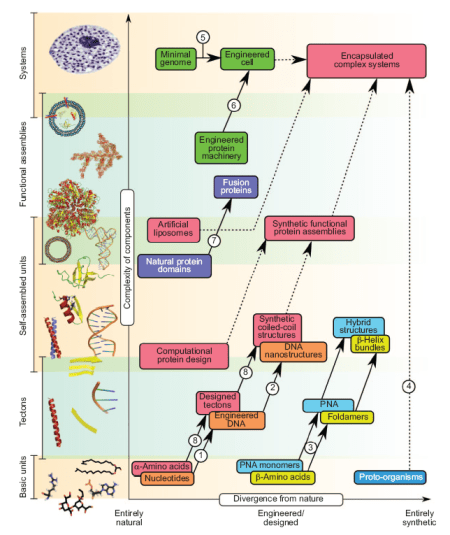
Peptide and Protein Building Blocks for Synthetic Biology - EHC Bromley et al.

 
Comments Off on Peptide and Protein Building Blocks for Synthetic Biology – EHC Broomley et al.

Posted by on February 4, 2008 in Biological engineering, Papers, Synthetic biology


Tags: , , ,