One short note: I’ve started this blog with a hope that maybe I would write something useful for the next Bio::Blogs edition, which would send me first visitors. To my surprise this site was found almost within hours from the first post by Pedro Beltrao. It looks like science bloggers never sleep :).
Last year I had a chance to make a short course on protein structure prediction. One of the points I made was preparing the publication quality pictures of the models. While the Rasmol (I’m linking to open source version here) has definitely its well deserved place on the scientists computers, it is not the best choice for publication figures. My personal suggestions are listed below:
- VMD by UIUC – my favourite, steep learning curve, writes POVRay files, recent version includes Tachyon renderer and is able to use a neat feature – “ambient occlusion“
- Chimera by UCSF – pretty easy to use, recent version can render biomolecules with POVRay
- Pymol by DeLano Scientific – easy as Rasmol, has internal renderer capable producing very nice images, another favourite for completely different reasons than VMD
- Qutemol by ISTI-CNR – pretty new software and to me still in alpha state, impressive real-time rendering with ambient occlusion, capable of producing images in prof. David Goodsell style (see Molecule of the Month at PDB)
- Molscript by Avatar Software, the oldest and the most difficult to use, however the clarity of the final image is often hard to beat
Of course three first programs can do much more than just visualize the protein structure – they can be used in detailed structural analysis, can do superimpositions of protein structures, analyze trajectories from molecular simulations, display density maps, deal with alignments and many other things.
Below you can find examples of images obtained with the above software. YadA adhesin picture has an “artsy” look, but at least it shows wide range of possibilities.
 VMD
VMD
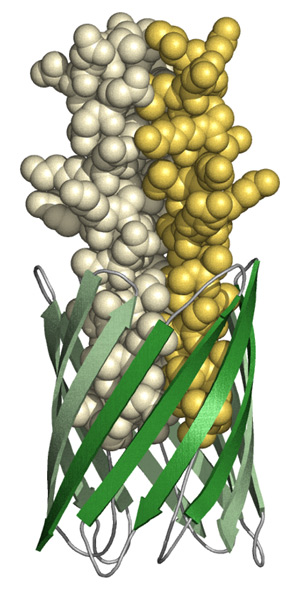 Pymol
Pymol
 Molscript


 Freelancing science
Why freelancing science?
There are many definitions of bioinformatics. They range from “handling biological data with a computer” to a very extensive and precise descriptions, including even subdivisions. In general they agree on one thing: bioinformatics is used for virtually unlimited number of tasks. Whether it’s a sequence analysis, handling microarray data, juggling chemical reaction parameters – as long as it’s around living things, it’s considered a bio(chem)informatics.
I don’t see a need to invent yet another name for it. But freelancing science keeps coming to my mind all the time. Switching the system your are working on during a coffee break or doing something in your own way instead of following “the protocol” has its “freelancing” feeling, doesn’t it? 🙂
Posted by Pawel Szczesny on August 7, 2007 in Comments